CJ needs help, where can he find it?

PLANT PORTALS

Who is CJ?

He is the protagonist in the series, The Landscape Architect.

The Landscape Architect is the title of a series of fictional autobiographies. These are CJ’s autobiographies. In this series, CJ reveals the twists and turns in the development of his career as a professional landscape architect via his interactions with cultures, landscapes, gardens and plants of the world—where the unexpected and downright strange become daily facts of life.

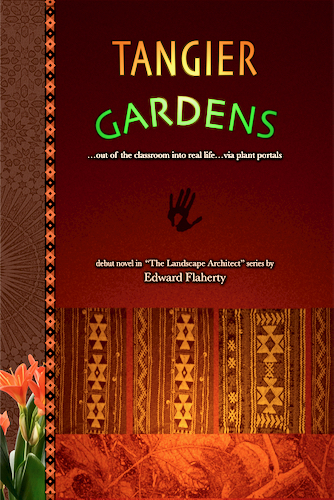
Tangier Gardens is the debut novel in that series.

When you dig into Tangier Gardens, you will find a contemporary coming of age action novel about CJ (Christopher Janus), who like us is facing a broad range of distressing challenges.

CJ needs a break. He has been busting his hump full time six years at university with one more class till graduation.

He wanted just a few moments of repose before getting on with his career.

Didn’t happen. We all sadly know that story. But how did CJ deal with it? Tangier Gardens is that story.

CJ, studying landscape architecture, is into pedestrian towns and warm sandy beaches. For his last class, a term abroad design study, he’s on his way to Tangier, a town with sandy beaches on the Med and a historical pedestrian district, the medina. 

However, crossing the Strait of Gibraltar and landing in Tangier immediately upsets his planned easy observe-and-check-the-box design study. He is thrown off balance and he has to start all over from scratch–no more easy study.

With Andalusian legacies, languorous gardens, Moroccan markets and ancient medinas, Tangier Gardens brings Mediterranean life to the armchair traveler.

If you are: 

-A nature lover, into urban gardening or a landscape architecture aficionado;

-Curious about all things green–the environment, plants, gardens, landscape;

-Intrigued about the North African multi-cultural, mystical history of people and plants, then

Tangier Gardens IS A MUST.

Tangier Gardens is my debut novel in the series The Landscape Architect. Is the landscape CJ’s worst enemy or is he his own worst enemy? Can he design his way out of this conundrum? Could coming of age be more awkward?

My Books

Tangier Gardens. Curious Tales.

I write travelogue adventure spiced with low fantasy landscape stories, set in exotic geographies, about people, seeking portals on strange journeys, who have unusual, captivating and inspiring interactions with plants, gardens and landscapes… the people most often emerging better. 

Low fantasy? Unusual, unexpected things happen to my characters in their daily lives that transport, that transform, that inspire them. I have been influenced by Kenneth Grahame, Algernon Blackwood, Rod Serling, Chris Carter and others. 

I’ve worked and lived in all the places I write about. Check them out. Tangier Gardens. Curious Tales.

Keywords: landscapes, gardens, plants, flowers, culture, landscape architecture, design, international, Middle East, North Africa, Europe, USA

Low Fantasy

Old Skool--I think not.

I think I’ve got it now… or is it just an ‘old skool’ trap?!

Tangier Gardens—what is it , where did it come from?

I wanted to make this post a pithy one-liner; but I can’t. 

Why? 

Because it is about my strange, significant life changes since retirement as a Landscape Architect, and since my stroke. So I hope you can get into it because many of you, as I, have the same deep love of landscape or landscape architecture.

It took me five years to write my first novel, Tangier Gardens: out of the classroom into the real world… via plant portals. It has taken another five years for me to figure out how that story actually fits into the nebulous domains of literature and publishing. Following is how I understand it.

Short answer: Tangier Gardens is low fantasy—oh, but what is that? 

I hesitate to rely on Wikipedia but after numerous cross-checks, I concluded they have the most concise/appropriate definition: 

“Low fantasy is a subgenre of fantasy fiction characterized by magical events intruding upon an otherwise normal, rational world. Unlike high fantasy, which occurs in entirely imaginary worlds (like Middle-earth), low fantasy stories are set on Earth or a recognizable historical landscape where the supernatural is a rare, hidden, or disruptive force. 

Key Characteristics of Low Fantasy

The Setting: Set in the primary, real-world (or an Earth-based historical period), meaning the laws of physics and society generally operate as we expect them to.

The Magic: Magic is clandestine, mysterious, or rare. It doesn’t shape the entire world (like dragons flying through the sky as a normal occurrence); instead, it exists in secret or feels uncanny.

The Scope: The narratives are often grounded, focusing on individual survival, gritty realism, or localized conflicts rather than saving the universe or continent-spanning wars.”

In conclusion: While low fantasy stands out as an intriguing, ever-present Tangier Gardens thread, it isn’t the whole picture. 

Striving to become a professional landscape architect, CJ, the Tangier Gardens protagonist, is unexpectedly overwhelmed by deep cultural roots–landscape legends. He wasn’t looking for legends—they found him.

Legends—from the Moors, from West Africa, from the Sahara—genies, fairies, charms where real life comes in contact with reality just beyond human understanding.

Paranormal? Metaphysical? Myths? Allegories? Fables? Legends? All are found in the landscape—where an ever-vibrant blend of human life and culture thrives—one step beyond. 

So what do we have: love of landscape, gardens, plants, landscape architecture, exotic geography, international adventure, horticulture and botany, and a protagonist’s personal and professional struggles through life. 

Tangier Gardens then is travel fiction with low fantasy. 

Hell, I ain’t famous but I sure had fun writing about where I’ve lived… exotic foreign places where I’ve worked, places I’ve called home.

Please share this with your friends having the same love of landscape.

The Foreshadowing

The summer’s dark green in the forest trees–only a few days of cooler weather and showers will bring…


Amanita muscaria–fly agaric

The iconic red and white mushroom, Amanita muscaria, found in all temperate climates under groves dominated by pines, birches or spruces, is most widely known as the fly agaric.

Easily identifiable by young and old, but confusing.

Poisonous, but edible if properly prepared.

Hallucinogenic–happiness and euphoria.

Myths, fairytales.

Delighting people from time immemorial.

Prominent in Alice in Wonderland, the Smurfs and Mario, the Italian plumber.

So…, what will it be for you?

Go out and find one first.

Under its cap even the little ones are safe.

Luckier than a four-leaf clover.

Band of Zwergs playing sweet music–have they eaten the mushroom?

At home.